ISO Compliance for UAE Businesses: What You Need to Know
ISO Certification To Be Used In Abu Dhabi: A Practical Guide For Local BusinessesThe business environment in Abu Dhafra has special pressures on ISO certification. Its structure is heavily influenced by the emirate's concentration of government bodies, large industries, and strict rules for tendering. For local firms who must navigate new certifications for the initial time understanding the particular challenges specific to Abu Dhabi makes the process considerably less daunting.Government and Semi-Government Tenders Set the Pace
The majority of Abu Dhabi's economy is run by companies that are linked to the government and major industrial players, a lot of which have formalised ISO certification as a prequalification requirement for contractors and suppliers. This means that the choice to seek certification is generally driven less by internal ambitions but rather by the reality of what contracts an organization wants to be able to continue receiving.
In the Energy and Industrial sectors, there are Specific Expectations
Abu Dhabi's energy and industry sectors carry particularly rigorous expectations in terms of environmental and safety, given the scale and risk profile of work within these fields. Companies that offer services to this environment, even indirectly, often find that certification expectations from their clients directly are more stringent than the guidelines, reflecting the organization's own internal organizational culture for risk management.
Picking a Standard That Fits your actual business needs
A common mistake to make is to seek a certification simply because an opponent has it, without first mapping out which certification really matches the company's risk profile and client expectations. The priorities of a logistics firm are quite different from those of a company that manages facilities, and starting with a clear-eyed assessment of what customers and tenders actually require can save energy later on.
The Gap Assessment Stage is an important one to consider
Before formally starting implementation A thorough gap evaluation against the relevant standard reveals how much existing practice already matches the requirements, and also where there is a need for more work. Doing this too quickly or skipping it could result in a long time, more expensive implementation afterward, as gaps which could have been identified in the beginning but are discovered later during the audit within the audit.
Documentation Requirements Are Much More Manageable than they sound.
A lot of first-time applicants think ISO documentation requirements will be excessive, however modern management system requirements are significantly less prescriptive regarding paperwork as the previous ones were focusing instead on demonstrating that processes are actually implemented rather than merely documenting. A pragmatic approach towards documentation, built around what the business is likely to want to track at all times, creates an effective system instead of one that's purely for audit purposes.
Local Support Options Have Explished The Options for Local Support Have Explended
Abu Dhabi now has a greater number of certification and consulting bodies who have a real understanding of the local market more than five years ago, reducing the necessity of relying solely on international companies with no on-the-ground situation. This expansion of local expertise has made the process faster and more in tune with the specific requirements of operating within the region.
Maintaining Certification Requires Ongoing Commitment
Certification isn't an isolated achievement but rather an ongoing commitment to regular surveillance audits, typically annually, to make sure that the management system is properly maintained. Companies that consider the initial certificate as the end of the line instead of the point at which they began have a difficult time with later audits. On the other hand, companies who have incorporated the requirements of the standard into daily routines will discover recertification to be much simpler.
Free Zone Businesses Face Some Particular Risks
Companies operating from the free zones of Abu Dhabi frequently assume that the certification requirements differ when compared to mainland businesses, however, the standard itself is exactly the same irrespective of jurisdiction. What does vary is the particular expectations for tenders and customers of each tenant ecosystem, which is worth clarifying directly with authorities of the free zone or prospective customers, rather then assuming that a blanket answer applies everywhere.
Budgeting in a Realistic Way for the Whole Process
The first-time applicants often budget just on the fee for external audit itself, overlooking the internal time investment, possible consultant costs, and any operational adjustments that are needed to close genuine gaps identified during assessment. A realistic budget takes into account the entire process from beginning of assessment to issued, rather than just the final audit invoice, to avoid an unpleasant surprise in the middle of the project.
Timing Certification Around Business Cycles
Businesses that have clear seasonal peaks like those found in construction and event-related industries, generally have a better time scheduling the more rigorous phases of implementation and audit at times when there is less noise, rather than trying to run an certification project with high operational demand. The certification authorities in Abu Dhabi are generally flexible with schedules, and adjusting timing preferences earlier in the process is likely to make the process more enjoyable for all those that is.
Leaning from Businesses that Have Previous Experience
Connecting directly to other Abu Dhabi businesses in a similar field who have completed certification frequently provides useful information that none of the consultants or certification bodies will divulge unprompted, for example, realistic timelines or aspects of the audit tend to catch applicants on and off. The peer perspective is genuinely valuable and worth actively seeking out before committing on a specific vendor or timeline.
Working With Government Liaison Requirements
The companies that seek certification specifically to be eligible for government tenders that are being offered in Abu Dhabi should confirm exactly which certification scope as well as standard version a particular tender calls for as requirements may refer to specific editions or requirements which aren't part of the standard international standard. Making sure to confirm this information with the tendering authority prior to starting the certification process eliminates the possibility of getting certification against the wrong scope.
The best way to ensure that Abu Dhabi businesses approaching certification for the first time, success typically comes down to choosing the appropriate level of certification for operating reality, taking the stage of preparation seriously and applying certification as an operational practice rather than just simply a checkbox to tick once and forget about. Abu Dhabi businesses that approach certification with this level, rather than taking it as a final-minute request to be rushed through, typically end up with a much stronger, more genuinely useful management system at the conclusion of the process. None of this needs to be handled on its own, as Abu Dhabi's growing base of knowledgeable local consultants and certification bodies means genuinely knowledgeable support is more accessible now than it has been at any time in the past. Benefiting from this growing local expert base makes the whole journey considerably more manageable than it was in the past. Follow the top rated ISO 27001 Certification for more info.
ISO 14001 Certification How Iso 14001 Certification Matters? Environmental Management Is Important For Uae Companies
Environmental considerations have moved from an unimportant issue to an important business consideration across the UAE, driven partly by the national commitment to sustainability and by the growing regulatory and client expectations. ISO 14001, the international standard for environmental management systems, is now an obvious choice for companies seeking to demonstrate true, solid environmental responsibility rather than good intentions alone.What ISO 14001 Actually Requires
The standard calls on businesses to assess the environmental effects of their work, consider the negative effects they have and set up systems in place to manage and minimize negative impacts in the course of time. This could mean anything such as reducing emissions or waste in a factory setting to the reduction of energy consumption and paper usage in a office-based service business, since this standard applies to any environmental impact a business's footprint looks like.
Alignment With the National Sustainability Goals
The UAE's national commitments concerning sustainability and net-zero goals have helped to create a true institutional momentum behind environmental management, and ISO 14001 certification gives individual companies a way to prove their commitment to those larger objectives. This has become increasingly important for businesses bidding on government or semi-government tenders, where environmental certifications are becoming a more precise evaluation criterion.
Industries Where It Matters Most
Manufacturing, construction oil and gas as well as logistics, are subject to the most direct environmental scrutiny given the size of their operations, but service-based companies are increasingly looking to obtain certification, too, for tender qualification and cost savings as a result of more efficient resource use. Even businesses with a low environmental footprint frequently find this method of organization reveals unforeseen efficiency potential.
Legal Compliance Angle Legal Compliance Angle
A substantial portion to ISO 14001 involves identifying and verifying compliance of relevant environmental legislation and rules and regulations. These requirements in the UAE environment spans federal environmental law and emirate-specific laws. Certified companies generally have a clearer and more current understanding of their regulatory obligations than their non-certified counterparts, lessening the possibility of accidental failure to comply and the consequent penalties.
Integration With Other Management Systems
Many UAE companies that are pursuing ISO 14001 already hold or are currently pursuing ISO 9001, and the two standards have the same structural features that using a unified management approach covering both standards is more effective instead of treating the two standards as distinct projects. This approach cuts down on duplicate the documentation and auditing process significantly when businesses manage multiple certifications.
What the Certification Process Will Look Like
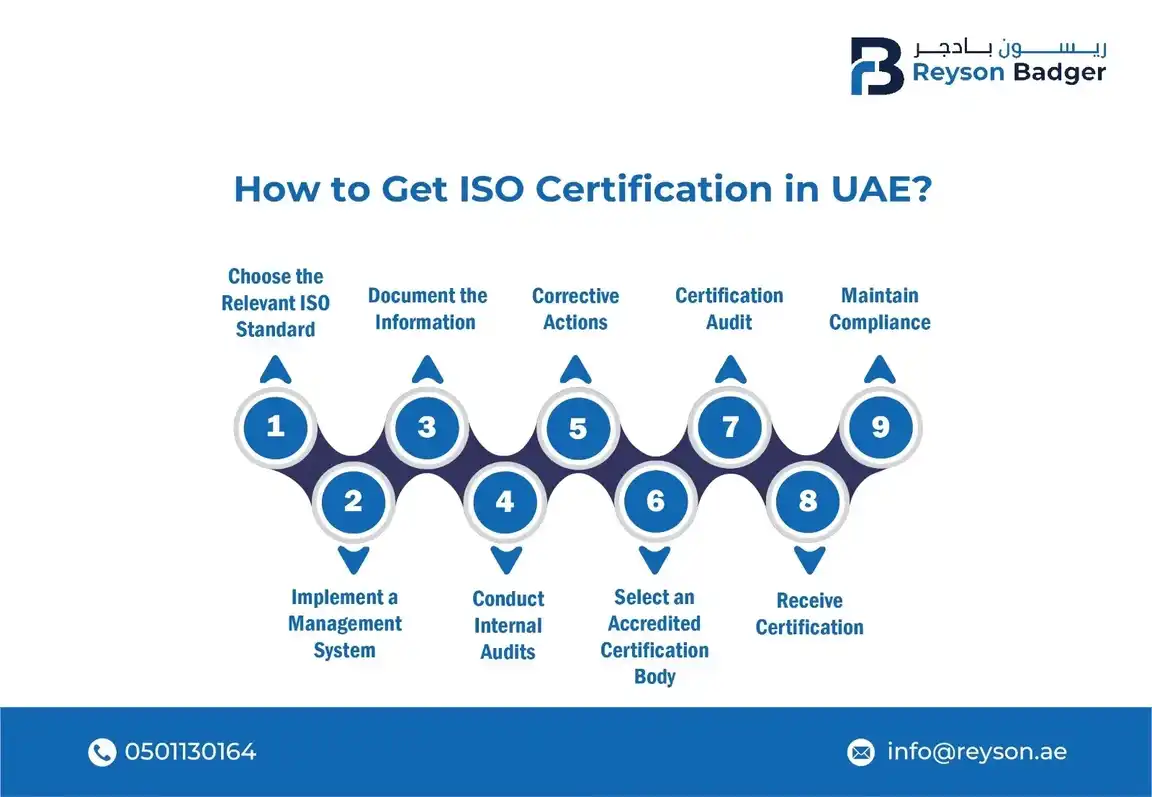
As with other management systems standards, certification follows a structured method: a beginning gap assessment, implementing necessary processes and documentation external audit, following that, an external two-stage audit which is carried out by a certified certification body. Continuous surveillance audits, which are typically annual, are a way to ensure that the environment management system is maintained properly rather than expiring once the initial certificate has been issued.
Actual Business Benefits and Benefits to Businesses Beyond the Certificate
Beyond tender eligibility and legal transparency, companies that have implemented ISO 14001 properly often uncover significant cost savings due to the more efficient use of resources and waste management, in addition to reputational benefits for environmentally conscious customers and business partners. These practical benefits are part of the reason that environmental certification has taken on a new meaning that goes beyond just a regulatory requirement for a large number of UAE businesses.
The Measurement of What's Really Important
An effective implementation of the ISO 14001 system focuses measurement efforts on the environmental aspects that genuinely matter for the particular business instead of tracking the metrics purely because they're easy to gauge. A logistics company could prioritize the use of fuel and efficiency in routes in comparison to a manufacturing company, which might concentrate more on water usage and waste production depending on where each company's actual environmental impact lies.
The process of engaging suppliers and contractors
Many UAE businesses realize that a meaningful share of their overall environmental impact is attributable to contractors and suppliers rather than directly with their own operations. ISO 14001 encourages businesses to think about this wider supply chain impact rather than taking environmental management for granted as an internal issue. It has led some certified UAE firms to inquire with their main suppliers to discuss how they manage their environment, resulting in an ongoing ripple effect through all of their supply chain.
Emergency Preparedness Part of the Standard
ISO 14001 requires businesses to consider the possibility of environmental emergency situations pertinent to their activities, such as chemical spills, or breakdowns in equipment that have environmental effects and have appropriate emergency plans in place rather than tackling such incidents reactively. This is a common way of revealing weaknesses that companies had not previously looked at, specifically in regards to staff training in emergency situations.
A Standard that Rewards Genuine Engagement
In the end, ISO 14001 rewards businesses who treat environmental management as an ongoing priority for their operations rather than a mere documenting process done once and forgotten. UAE businesses that incorporate the principles of the standard into daily management decisions, rather that separating it within an independent compliance function typically reap the most substantial environmental and branding benefits as time passes.
The Management of Water is Particularly Important in the UAE In the context of
In light of the climate that is arid in the United Arab Emirates and dependence on desalinated water using and management of water, the UAE is frequently a focus of an ISO 14001 system compared with regions where water scarcity is less of a concern. Businesses that integrate water efficiency into their management of environmental issues from the beginning tend to see this as one of the most practically valuable aspects of certification in the local situation.
For UAE firms that are certified to ISO 14001, the certification is both a response real market and regulatory pressure and a structured opportunity to address environmental issues more deliberately, which increasingly is of interest to regulators, clients, and the UAE's own sustainable development goals across the nation. As environmental expectations in the UAE are rising Businesses that have a solid eco-friendly management capabilities right now, rather than waiting for it to become an unavoidable necessity, are likely get a head start to succeed in the years ahead. All of this should not be a burden for small businesses since the usual scales proportionately, and even modest effective environmental measures implemented regularly are likely to please auditors greater than an ambitious strategy which never sees the light of day through. Consistency, and not just the mere pursuit of ambition, is what auditors as well as genuine positive environmental outcomes alike reward. small, gradual changes tend over ambitious goals that seem to stall in the initial few months. Check out the top rated ISO 20000 Certification for site advice.
